Exquisite Gold Branch Chandelier with Glass Leaves
The “Exquisite Gold Branch Chandelier with Glass Leaves” is a decorative lighting fixture characterized by its intricate design, metallic finish, and incorporation of glass elements. This article will explore its historical context, design principles, material composition, manufacturing processes, installation, maintenance, and its place within the broader spectrum of decorative lighting.
The genesis of chandelies Nanolamps, including those incorporating naturalistic motifs, can be traced back through centuries of decorative arts. Early chandeliers, often functional rather than purely ornamental, evolved from simple candle-holding arrangements suspended from the ceiling. The advent of more sophisticated metalworking techniques allowed for increasingly elaborate designs.
Renaissance and Baroque Influences
During the Renaissance, chandeliers began to take on more artistic forms. Metalworkers crafted intricate scrolls and figures, often gilded or made from bronze, to enhance the perceived opulence of dining halls and noble residences. The Baroque period further amplified this trend, with chandeliers becoming grand statements of power and wealth, frequently featuring cascading elements and a proliferation of light sources. The “Exquisite Gold Branch Chandelier with Glass Leaves” echoes this historical inclination towards elaborate and visually rich fixtures.
The Rise of Naturalism in Decorative Arts
The 18th and 19th centuries saw a growing appreciation for natural forms permeating decorative arts. Floral motifs, foliage, and branch-like structures became popular in furniture, textiles, and lighting. This period witnessed a shift towards incorporating organic shapes into manufactured objects, a trend that directly informs the design of branch-like chandeliers. The meticulous articulation of branches and leaves in the “Exquisite Gold Branch Chandelier with Glass Leaves” reflects this historical embrace of naturalism.
Art Nouveau and Its Legacy
The Art Nouveau movement, flourishing in the late 19th and early 20th centuries, placed a significant emphasis on flowing lines, organic forms, and the integration of nature into design. Artists and craftspeople of this era often drew inspiration directly from plants, flowers, and insect life. While the “Exquisite Gold Branch Chandelier with Glass Leaves” may not be a direct product of the Art Nouveau movement, its stylistic leanings towards sinuous, organic forms and its detailed representation of botanical elements find a kinship with the artistic philosophies of that time. The flowing, almost sinuous, lines of the fixture can be seen as a distant echo of Art Nouveau’s rejection of rigid, geometric forms.
Design and Aesthetics of the Exquisite Gold Branch Chandelier with Glass Leaves
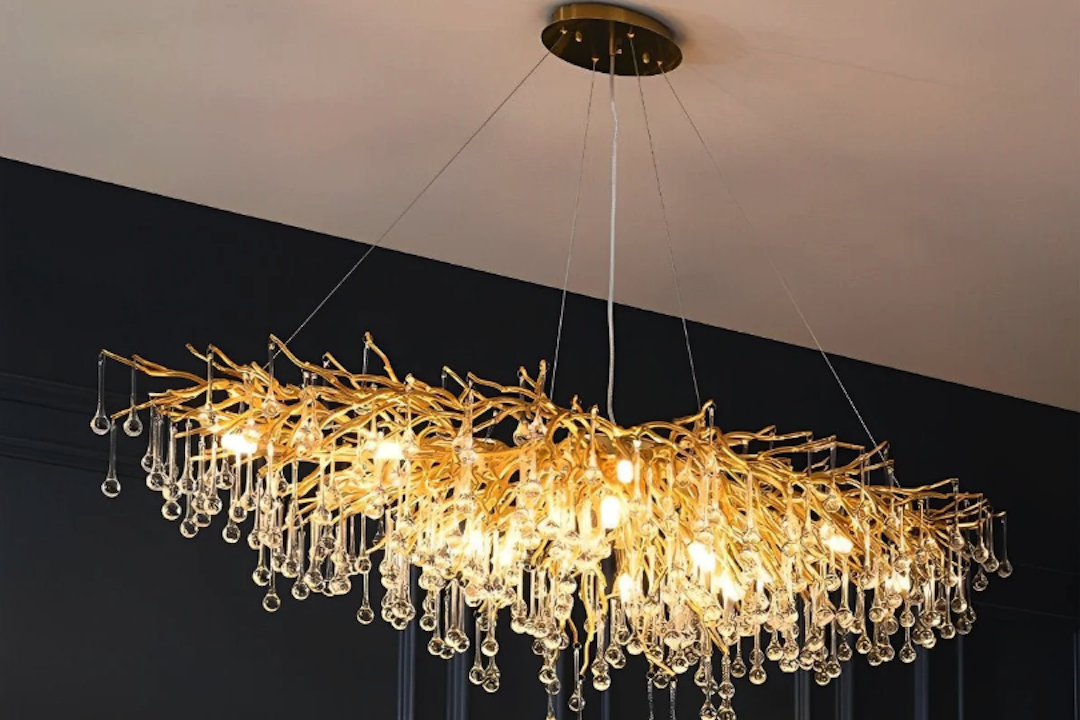
The “Exquisite Gold Branch Chandelier with Glass Leaves” is distinguished by its simulated botanical structure, where metallic branches spread radiantly, supporting a multitude of glass “leaves.” The overall aesthetic aims to evoke the natural beauty of a tree or a collection of branches illuminated by light.
The Branch Structure: A Foundation of Form
The primary visual element of the chandelier is its branched framework. These branches are typically crafted from metal and are often finished in a gold hue, contributing to the fixture’s name and its perceived richness. The design can vary significantly, ranging from a central trunk-like structure with multiple arms extending outwards, to a more decentralized arrangement where branches appear to grow organically in different directions.
Articulation and Realism
The level of detail in the branchwork is a key differentiator. Some designs feature simply shaped rods, while others boast a high degree of articulation, mimicking the natural twists, turns, and junctions of real branches. The casting or fabrication of these metallic elements allows for varying textures and curves, contributing to the overall realism of the representation. This meticulous shaping is akin to a sculptor carefully chiseling stone to reveal the form within.
The Gold Finish: A Symbol of Light and Value
The gold finish, whether achieved through plating, painting, or a patinated metal, plays a crucial role in the chandelier’s aesthetic. It reflects light, enhancing the luminosity of the fixture, and imbues it with a sense of luxury and timelessness. The color can range from a bright, polished gold to a more muted, antique gold, each offering a distinct visual impact.
The Glass Leaves: Elements of Light and Transparency
The “leaves” adorning the branches are a defining characteristic. These are typically made from glass, offering a translucent or transparent quality that interacts with light in specific ways. The shape, size, and texture of these glass elements contribute significantly to the overall visual effect.
Materiality of Glass
The glass used can vary. Common types include:
- Blown Glass: This allows for a wide range of shapes and sizes, from delicate, delicate petals to more substantial, sculpted forms.
- Cut Glass: This technique can create faceted surfaces that refract and reflect light with greater intensity, adding sparkle and brilliance.
- Frosted or Etched Glass: These treatments can diffuse light, creating a softer, more ambient glow, and can also mimic the veined texture of real leaves.
The choice of glass directly influences how the chandelier illuminates a space. It acts as a prism, breaking down and scattering light, much like sunlight filtering through a canopy of real foliage.
Coloration and Texture of Leaves
While clear glass is common, leaves can also be colored, often in subtle greens, amber, or even iridescent hues, to further enhance the botanical illusion. Textures can range from smooth and polished to deliberately irregular or rippled, adding tactile and visual interest. The interplay of light and shadow across these varied textures creates a dynamic visual experience.
Material Composition and Manufacturing
The construction of an “Exquisite Gold Branch Chandelier with Glass Leaves” involves the careful selection and assembly of various materials. The manufacturing process bridges artisanal techniques with modern production methods.
Metallic Components: Branches and Frame
The primary structural elements, the branches and the central supporting frame, are typically made from metals such as brass, iron, or aluminum. The choice of metal influences the weight, durability, and cost of the fixture.
Metalworking Techniques
- Casting: This is a common method for creating intricate branch designs. Molten metal is poured into a mold, allowing for complex shapes and details to be replicated. This technique is akin to a baker pouring batter into a beautifully intricate waffle iron.
- Forging: This process involves shaping metal by heating it and then hammering or pressing it. It can create robust and uniquely formed branches.
- Welding and Soldering: These techniques are used to join individual metallic components together, forming the overall chandelier structure.
- Stamping and Pressing: For simpler designs or repetitive elements, these methods can be employed to mass-produce metallic parts.
Surface Treatments and Finishes
Once the metallic structure is formed, it undergoes surface treatments to achieve the desired aesthetic and protective qualities.
- Plating: This involves coating the base metal with a thin layer of another metal, most commonly gold or brass, to achieve the characteristic gold finish.
- Painting and Powder Coating: These methods offer a wide spectrum of colors and finishes, including various shades of gold. Powder coating provides a durable and uniform surface.
- Patination: This process intentionally alters the surface of the metal to create an aged or antique appearance, often mimicking natural oxidation.
Glass Components: Leaves and Embellishments
The glass leaves are a critical component, and their production is as varied as the types of glass used.
Glassblowing and Shaping
- Hand-Blown Glass: Skilled artisans shape molten glass into the desired leaf forms. This process allows for unique variations in each leaf, contributing to the organic feel of the chandelier. The artist’s breath is quite literally infused into the creation, shaping the glass as it cools.
- Molding: Glass can be pressed or cast into pre-determined leaf molds, which is a more efficient method for producing uniformly shaped leaves.
Coloring and Texturing of Glass
- Coloring: Glass can be colored during the manufacturing process by adding metal oxides or other compounds to the molten glass. Alternatively, colored glass can be applied as a coating.
- Texturing: Techniques such as etching, sandblasting, or applying textured surfaces can be used to mimic the natural veins and surfaces of leaves.
Assembly and Electrical Components
The final stage involves the careful assembly of all components and the integration of electrical wiring for illumination.
Wiring and Socket Integration
Each light source is connected to a wiring system that runs discreetly through the metallic branches. Sockets are designed to hold light bulbs and are often concealed within the structure to maintain the illusion of botanical growth.
Hanging Mechanisms
Robust hanging mechanisms, such as chains, cables, or direct mounting plates, are essential to securely support the weight of the chandelier and ensure its safe installation.
Installation and Maintenance
Proper installation and regular maintenance are vital for the longevity and continued aesthetic appeal of the “Exquisite Gold Branch Chandelier with Glass Leaves.”
Installation Considerations
- Structural Support: The weight of the chandelier must be adequately supported by the ceiling joists or a suitable mounting plate. A professional electrician should assess the load-bearing capacity of the ceiling.
- Electrical Connection: Connecting the chandelier to the building’s electrical system should be performed by a qualified electrician to ensure safety and compliance with local building codes. This involves connecting the main power supply to the chandelier’s wiring.
- Height and Placement: The height at which the chandelier is hung is crucial for both illumination and aesthetic balance. It should not obstruct pathways or views, and its visual impact should be considered in relation to the overall room design.
Cleaning and Care
The delicate nature of the glass leaves and the finish of the metallic components necessitate gentle cleaning practices.
Cleaning the Glass Leaves
- Regular Dusting: A soft, dry microfiber cloth can be used for routine dusting.
- Damp Cloth Cleaning: For more stubborn marks, a slightly damp cloth (water only or with a mild, non-abrasive cleaner) can be used. It is essential to dry the glass immediately afterward to prevent water spots.
- Avoid Harsh Chemicals: Abrasive cleaners, ammonia-based solutions, or solvents can damage the glass surface or its coloring.
Cleaning the Metallic Components
- Gold Finish: Depending on the type of gold finish, cleaning methods will vary. For plated finishes, a soft cloth with mild soap and water is generally recommended. Harsh scrubbing can wear away the plating.
- Polished or Antiqued Finishes: Specific metal polishes designed for the particular metal and finish should be used sparingly, following the manufacturer’s instructions.
Bulb Replacement
Replacing bulbs should be done with the power supply to the chandelier switched off at the main breaker. Care should be taken when reaching for bulbs, especially if they are located within intricate branch structures.
The “Exquisite Gold Branch Chandelier with Glass Leaves” in Context
The “Exquisite Gold Branch Chandelier with Glass Leaves” occupies a specific niche within the vast landscape of decorative lighting. Its design elements reflect broader trends in interior design and the enduring human fascination with replicating natural forms.
Categories of Decorative Lighting
This type of chandelier falls under the category of statement lighting or accent lighting, designed to be a focal point in a room. It moves beyond mere functional illumination to become a significant decorative object.
Classification and Typology
Within the broader classification of chandeliers, this fixture can be described as a nature-inspired or botanical chandelier. It shares characteristics with other “tree” or “branch” chandeliers, often employing similar motifs of wood, metal, and embellishments that mimic plant life.
Market Positioning and Consumer Appeal
The appeal of the “Exquisite Gold Branch Chandelier with Glass Leaves” often lies in its ability to add a touch of elegance, whimsy, or grandeur to a space. It can be found in a range of price points, from mass-produced interpretations to custom-made artisanal pieces.
Target Audiences and Interior Styles
This fixture can be well-suited for various interior design styles, including:
- Transitional: Blending traditional and contemporary elements.
- Eclectic: Where a mix of styles and periods are brought together.
- Glamorous or Hollywood Regency: Where opulence and rich materials are emphasized.
- Contemporary: As a striking and sculptural element in a modern setting.
The “gold” finish and the “glass leaves” contribute to a sense of luxury and visual interest, making it a popular choice for dining rooms, living rooms, entryways, and bedrooms where a pronounced decorative statement is desired.
Comparison with Other Chandelier Designs
Compared to geometric or minimalist chandeliers, the “Exquisite Gold Branch Chandelier with Glass Leaves” offers a distinctly organic and ornate aesthetic. While a minimalist chandelier might prioritize clean lines and functional form, this design prioritizes intricate detailing, naturalistic representation, and a more elaborate interplay of light and shadow. It is a visual narrative woven from metal and glass, telling a story of natural beauty transformed into an art object. Its complexity is a deliberate departure from the simplicity found in other lighting fixtures, aiming to create a sense of wonder and depth.